
Choose Ben Tre for rural immersion. Choose Can Tho for a city base and floating market.
If your ideal Mekong experience is cycling through coconut villages, entering narrow canals and sleeping at a small family farmstay, choose Ben Tre. If your priority is Cai Rang floating market, a lively riverfront, a wider choice of restaurants and easier transport connections, choose Can Tho. With three or four days, visit both: they show different sides of the Delta.
Guests often ask me which destination is “better.” I live in Ben Tre and host travellers here, but the honest answer is that the choice depends on the trip you want. Ben Tre and Can Tho are not interchangeable versions of the same place.
The Ben Tre area is shaped by coconut gardens, village lanes, smaller waterways and dispersed communities. Can Tho is the Delta’s major urban centre: busier, better connected and known internationally for Cai Rang floating market. Comparing them only by a list of attractions misses the more important difference—how your days will feel.
Ben Tre vs Can Tho at a glance
This table is a planning shortcut, not a promise that every part of Ben Tre is peaceful or every part of Can Tho is busy. Ben Tre City has traffic and services; Can Tho also has orchards and quiet countryside. The comparison describes the experience most international visitors usually build around each destination.
What actually feels different?
Ben Tre: the experience is between the attractions
In rural Ben Tre, the memorable moments are often small: riding under coconut palms, stopping at a working village market, watching someone cross a narrow bridge, sharing fruit from the garden or hearing the river after dark. There may be fewer famous landmarks, but the landscape becomes the experience.
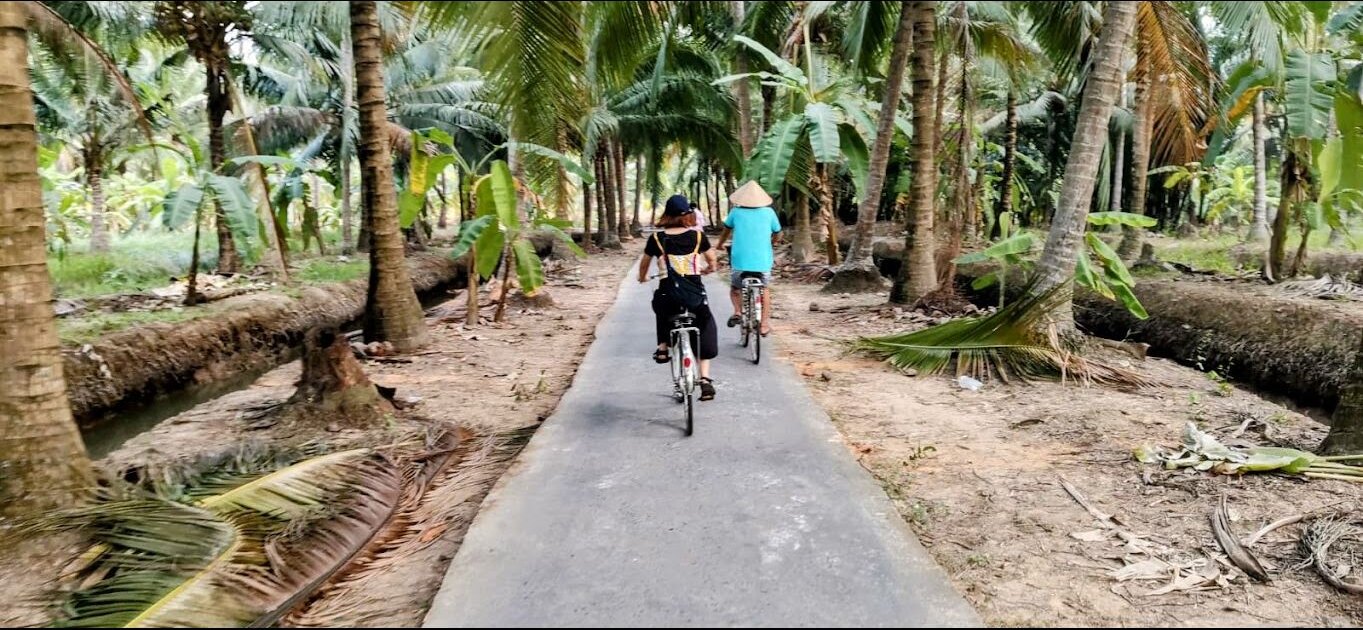 Cycling reveals how homes, gardens, markets and waterways connect. Photo: Coco Happy Farm.
 A hand-rowed sampan can enter waterways that larger boats cannot. Photo: Coco Happy Farm.
The trade-off is convenience. Rural stays are farther from bus terminals, restaurants and nightlife. A good host should help with the last kilometres, realistic activity timing and onward travel. Guests who expect to step outside into a tourist centre may find the countryside too quiet.
Can Tho: more energy and an early river morning
Can Tho offers the comfort of a regional city. It is easier to find varied food, cafés, pharmacies, larger hotels and onward buses. Ninh Kieu riverfront gives visitors somewhere easy to walk in the evening, and Cai Rang floating market provides a clear reason to wake before sunrise.
The floating market should be understood honestly. It is a working wholesale market whose scale and character have changed over time; it is not a permanent festival arranged for tourists. Go early, choose a responsible small-boat operator and value the river commerce that remains rather than expecting an old postcard to come alive on demand.
Ben Tre is usually better for entering the landscape. Can Tho is usually better for observing the Delta as a regional centre. One puts village life around your accommodation; the other gives you urban comfort with access to river excursions.
Which destination fits your trip?
- A family-run farmstay or countryside homestay
- Village cycling on mostly flat, quiet lanes
- Coconut farms and narrow nipa-palm canals
- A slower evening with sunset or wild fireflies
- Fewer organised attractions and more local rhythm
- Cai Rang floating market as a main priority
- More restaurants, cafés and evening activity
- A wider range of hotels and city services
- Simpler bus connections to other southern destinations
- A destination that works without a rural host
For couples and slow travellers
Ben Tre usually offers more privacy and calm, especially when you stay outside the city. A river evening, family meal and unhurried morning work well for travellers who do not need nightlife. Can Tho suits couples who prefer a polished riverside hotel and an evening walk with more dining choices.
For families
Can Tho is easier when access to shops, taxis and familiar hotel facilities matters. Ben Tre can be more engaging for children who enjoy bicycles, boats, gardens and farm animals, but parents should confirm life jackets, bicycle confidence, heat breaks and transport before arrival.
For solo travellers
Can Tho makes independent logistics easier and offers more places to go after dinner. Ben Tre works well when a solo guest books a host-led experience or stays somewhere that helps connect the rural pieces; otherwise the quiet location can feel isolating rather than peaceful.
Should you visit both?
Yes, if you have at least three days in the Delta. Ben Tre and Can Tho complement rather than duplicate each other. A sensible route is:
- Day 1 — Ben Tre: arrive, settle into a rural stay, then take a late-afternoon river and canal experience.
- Day 2 — Ben Tre: cycle in the cooler morning, eat locally and keep part of the afternoon free.
- Day 3 — Can Tho: travel after breakfast or lunch, check in and enjoy the riverfront in the evening.
- Day 4 — Can Tho: visit Cai Rang early, return for breakfast, then continue your journey.
If you only have one night, do not attempt both. Choose the place that matches your priority and experience it without spending half the visit in a vehicle. For a Ben Tre-only plan, compare our two-day and three-day itineraries.
Travel between Ben Tre and Can Tho
From Coco Happy Farm to central Can Tho, allow about 2 hours 30 minutes by private car. The distance is not the only issue: rural roads, bridges and city traffic affect the journey. A private car is the simplest option for families, groups, heavy luggage or a fixed hotel check-in.
A direct local bus can be cheaper, but allow roughly three hours or more and confirm the current pickup point and departure. Services have previously passed near Coco Happy Farm around 9:15 AM and 3:00 PM, but local timetables can change and should never be treated as permanent without checking.
Leaving Ben Tre after breakfast or lunch gives a calmer arrival in Can Tho. If Cai Rang is planned for the next morning, sleep in Can Tho the night before—the market is too early for a sensible same-day transfer from rural Ben Tre.
A local host’s final verdict
I would choose Ben Tre for travellers who ask to see ordinary rural life and are comfortable with simple, family-run hospitality. I would choose Can Tho for travellers who mention the floating market first, want more independence or need easier transport. I often recommend visiting Ben Tre first and Can Tho second: the journey moves naturally from a quiet village experience to a better-connected city.
What I would not recommend is choosing Ben Tre because someone promises it is “untouched,” or choosing Can Tho because a photograph makes the floating market look guaranteed. Both places are living communities. Visit with realistic expectations and each can be rewarding for a different reason.
Frequently asked questions
Is Ben Tre or Can Tho better for a first Mekong Delta trip?
Choose Ben Tre for quiet coconut villages, cycling, small canals and a rural homestay. Choose Can Tho for an easier city base, the Cai Rang floating market, more restaurants and stronger onward transport. Neither is universally better.
Can I visit both Ben Tre and Can Tho?
Yes. If you have three or four days, the two places complement each other well. Spend one or two nights in rural Ben Tre, then continue to Can Tho for one or two nights rather than treating either as a rushed stop.
How long does it take to travel from Ben Tre to Can Tho?
From Coco Happy Farm, allow roughly 2.5 hours by private car. A direct local bus can take around three hours or longer because of stops and transfers. Confirm current departures before travel.
Which place is better for the floating market?
Can Tho. Cai Rang is the region’s best-known operating floating market, although it is a working wholesale market and visitors need an early start. Ben Tre is not the right choice if a large floating market is your priority.
Which is less touristy, Ben Tre or Can Tho?
Rural Ben Tre generally feels quieter and less visitor-oriented, especially away from the city and popular day-tour routes. Can Tho receives more visitors but still has ordinary neighbourhoods, local food and countryside beyond its riverfront.
Which destination is better for families?
Both can work. Can Tho is simpler for families wanting city services and short transfers. Ben Tre suits families who enjoy bicycles, gardens and small-scale farm life, provided boat and bicycle arrangements are discussed in advance.
Still deciding between Ben Tre and Can Tho?
Send Coco Happy Farm your arrival city, number of nights and the experience you care about most. Thuần can give you an honest answer—even when Can Tho fits your trip better. Message Thuần on WhatsApp.
Local information note: This comparison was reviewed in August 2026 and is based on hosting international guests in Ben Tre and helping many continue to Can Tho. Transport times, bus departures, river conditions and market activity change; confirm practical details before travel.