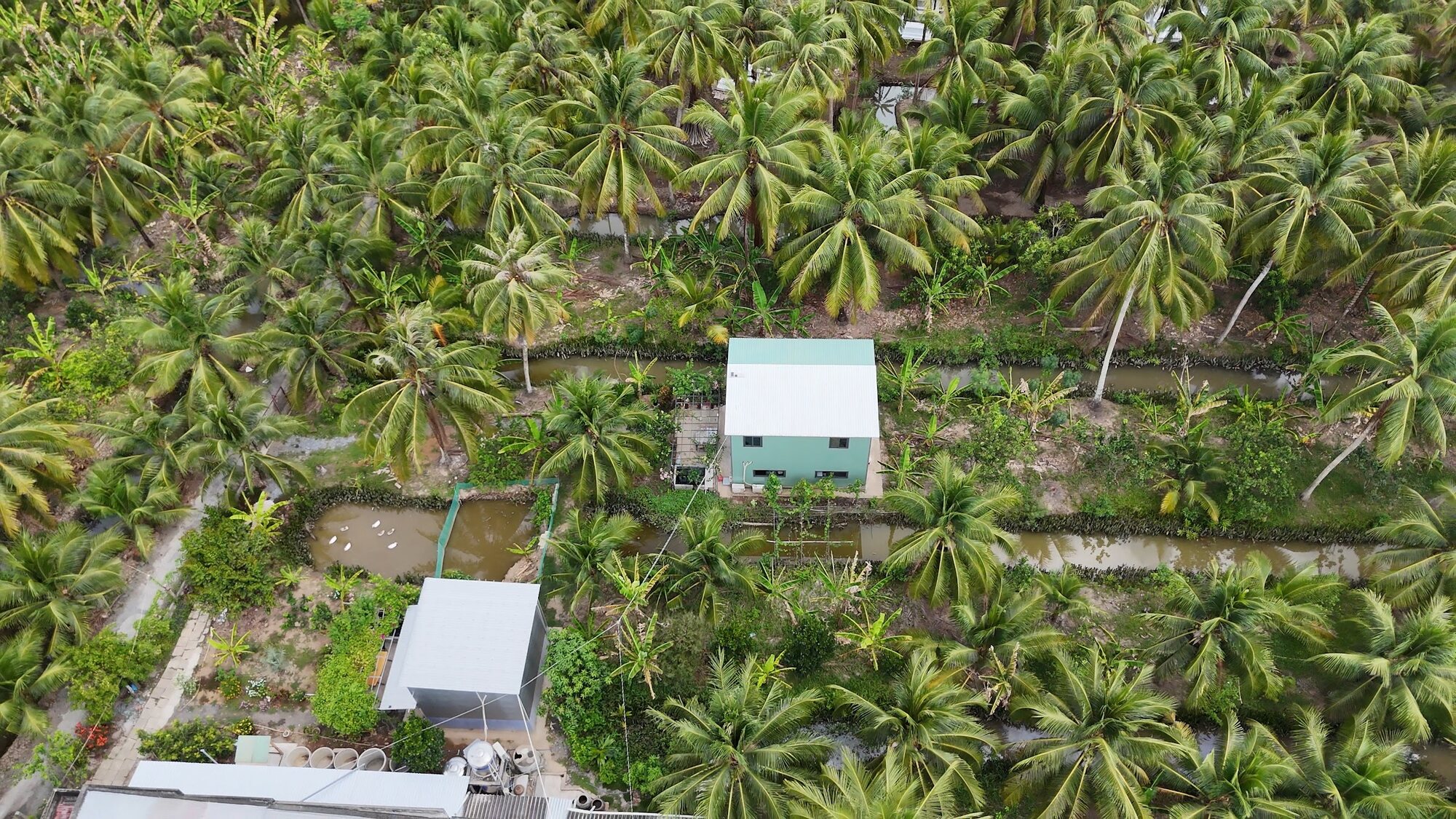
Our family has lived and worked on this coconut land for at least four generations.
It may be longer. The living members of our family cannot now trace the exact number with certainty, so “at least four generations” is the most accurate way to tell it.
I was born on this land in Lương Hòa, as were generations of my family before me. In Ben Tre, this does not make us unusual. Coconut gardens are part of the everyday landscape. What makes this place personal is not that we have coconut trees, but the work, memories and relationships that have grown around them.
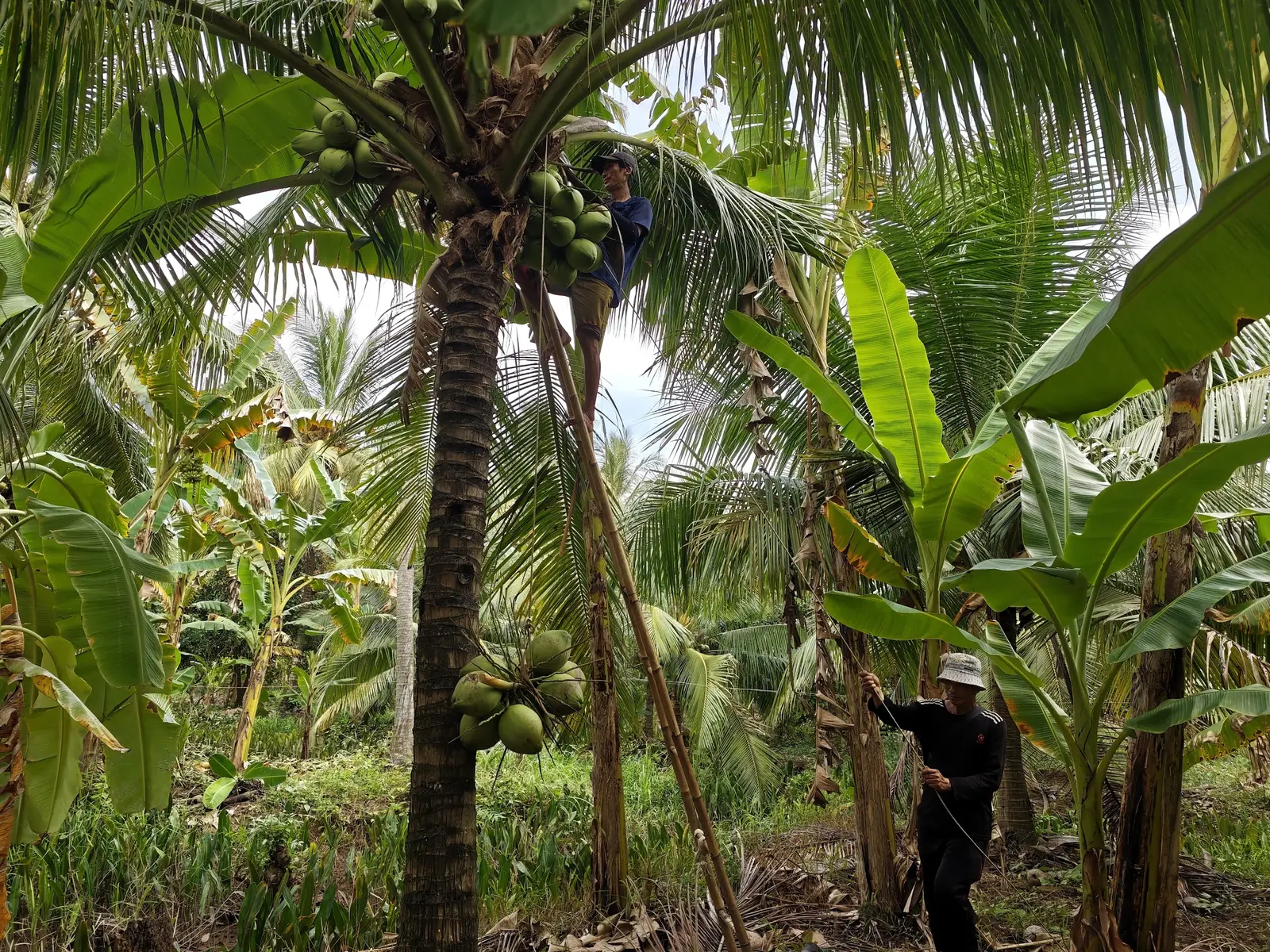
The work I remember from childhood
My father harvested coconuts using a long bamboo pole—a task we call giựt dừa. My mother carried the coconuts in baskets hung from a shoulder yoke. When coconuts fell into the canals, I used a forked pole, a cây chỉa, to pull them back to the bank.
These details matter because coconut farming is more than a green background. Every fruit must come down, be gathered, carried and sold or used. Coconuts become drinks and food, candy and oil, household tools, fuel and materials. The tree connects the family garden to a much wider local livelihood.
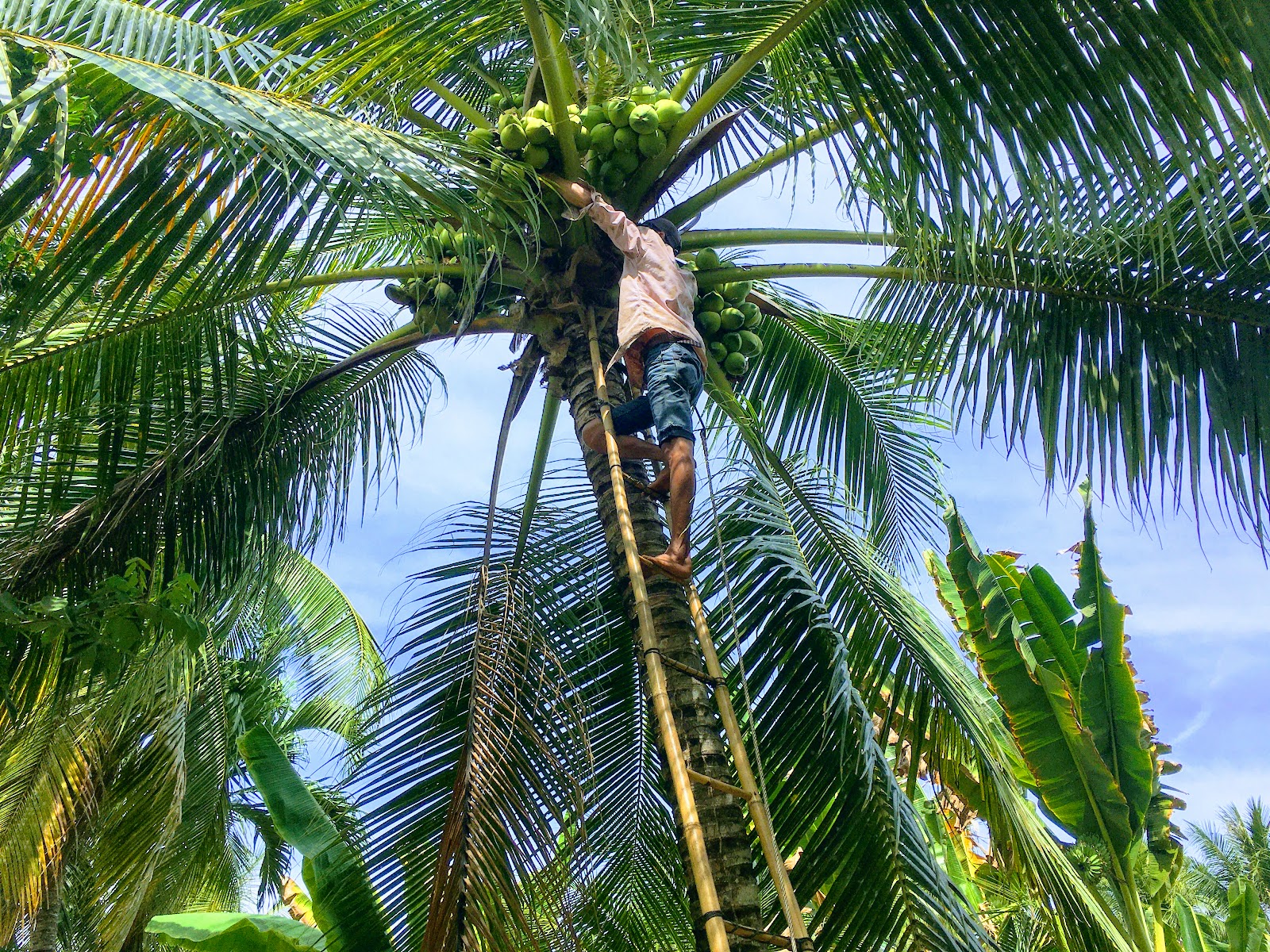 Harvesting knowledge is physical, practical and passed between generations.
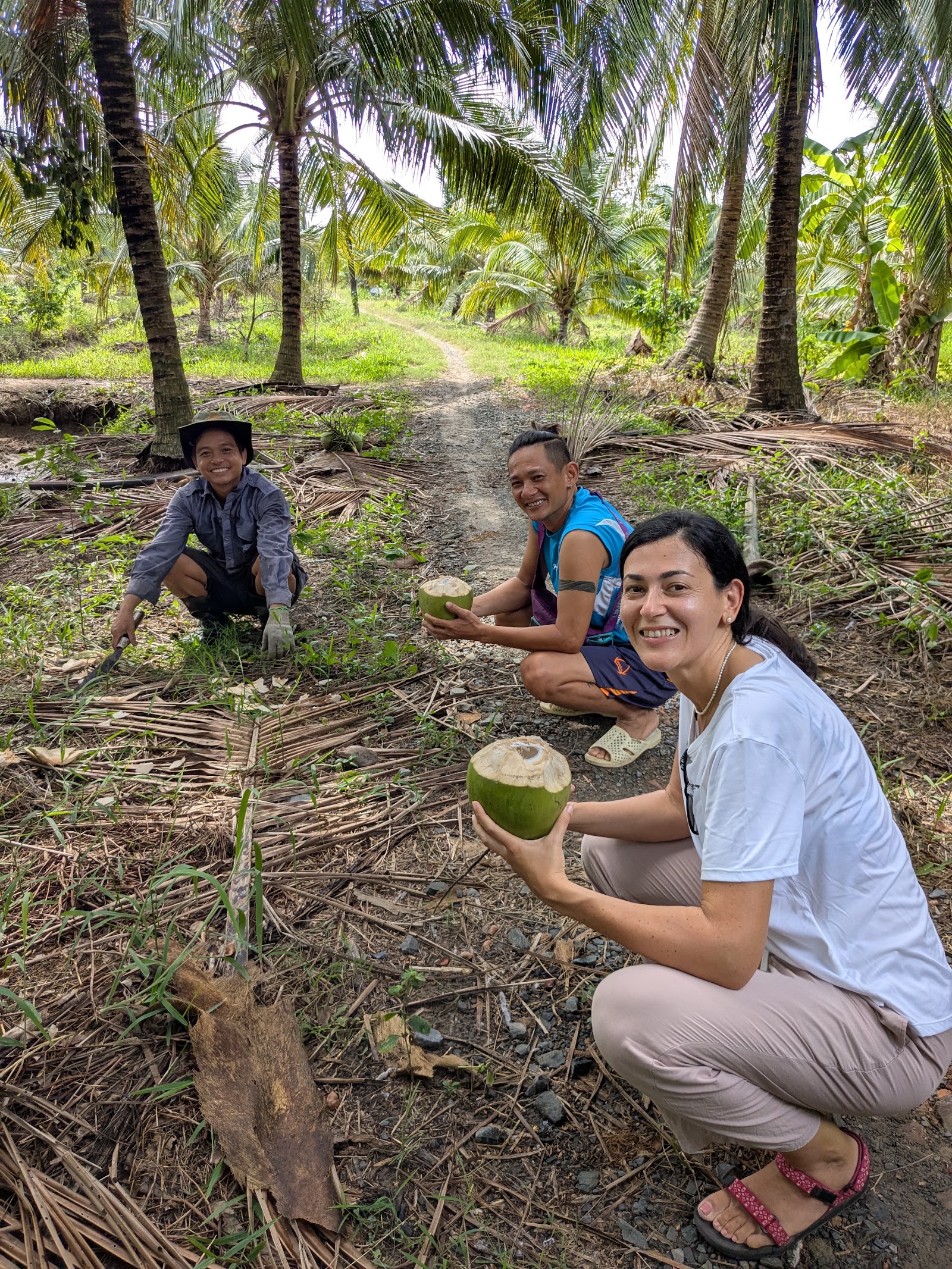 The simplest ending to a harvest: opening a coconut and sharing it where it grew.
The following is family oral history—not verified historical fact.
Our family has no surviving document that confirms the people, place or events in this older story. Details may have changed as it passed from one generation to the next. We share it as family memory, not as evidence.
The story our elders passed down
In our family’s telling, an ancestor several generations ago began life with very little land and was sent far away to a French penal colony for political reasons. Some versions remembered within the family connect the place with Cayenne in French Guiana, but we cannot verify that location.
The story says that he later returned home with a valuable stone and used what it brought him to acquire land. That land became part of the foundation from which later generations farmed and raised their families.
We do not know which parts can be confirmed. The responsible way to keep the story is to preserve both its meaning and its uncertainty: it tells us how our family remembers hardship, distance, return and the importance of having land, but it should not be read as a documented account of colonial history.
Leaving—and returning home in 2017
I worked as a tour guide before returning to my village in 2017. Tourism had shown me that many international travellers wanted more than a quick sightseeing stop. They wanted time with people, a real place to stay and enough context to understand what they were seeing.
That year I began welcoming overnight guests on our family land. Coco Happy Farm paused during the COVID period and began operating again in 2022. The guest rooms came later than the garden; the farm and family life were already here.
Why I called it Coco Happy Farm
I chose the name. “Coco” fits Ben Tre because coconut gardens are everywhere. “Happy” describes what I wanted the place to create: genuine joy for guests, for my family and for local people who share their time and knowledge.
We don’t offer luxury. We offer a life that’s real.
What continues today
My parents still garden, care for trees and harvest produce. My sister Thúy looks after food and joins my mother in the kitchen. My partner, Yếu, shares coconut-leaf handicrafts when available. I host our guests and guide the daily village cycling experience.
Visitors may see a harvest or quiet farm work when it is genuinely happening, but we do not create a false schedule for it. Seasonal fruit depends on the garden. Coconuts come down when the trees are ready. The purpose of Coco Happy Farm is not to manufacture a more attractive version of rural life, but to make the real one easier to see and understand.
Come as a guest. Meet the place as it is.
Read more about the family behind Coco Happy Farm, explore food and farm life, or see the three ways to stay.
Editorial note: Sections describing Thuần’s childhood, present-day family roles and the farm’s opening are first-hand family accounts. The older ancestor story is explicitly identified as oral history because no supporting family document is currently available. All photographs are original Coco Happy Farm images.